




Solar Street Light Price in Bangladesh (2026) – Tender & Bulk Guide

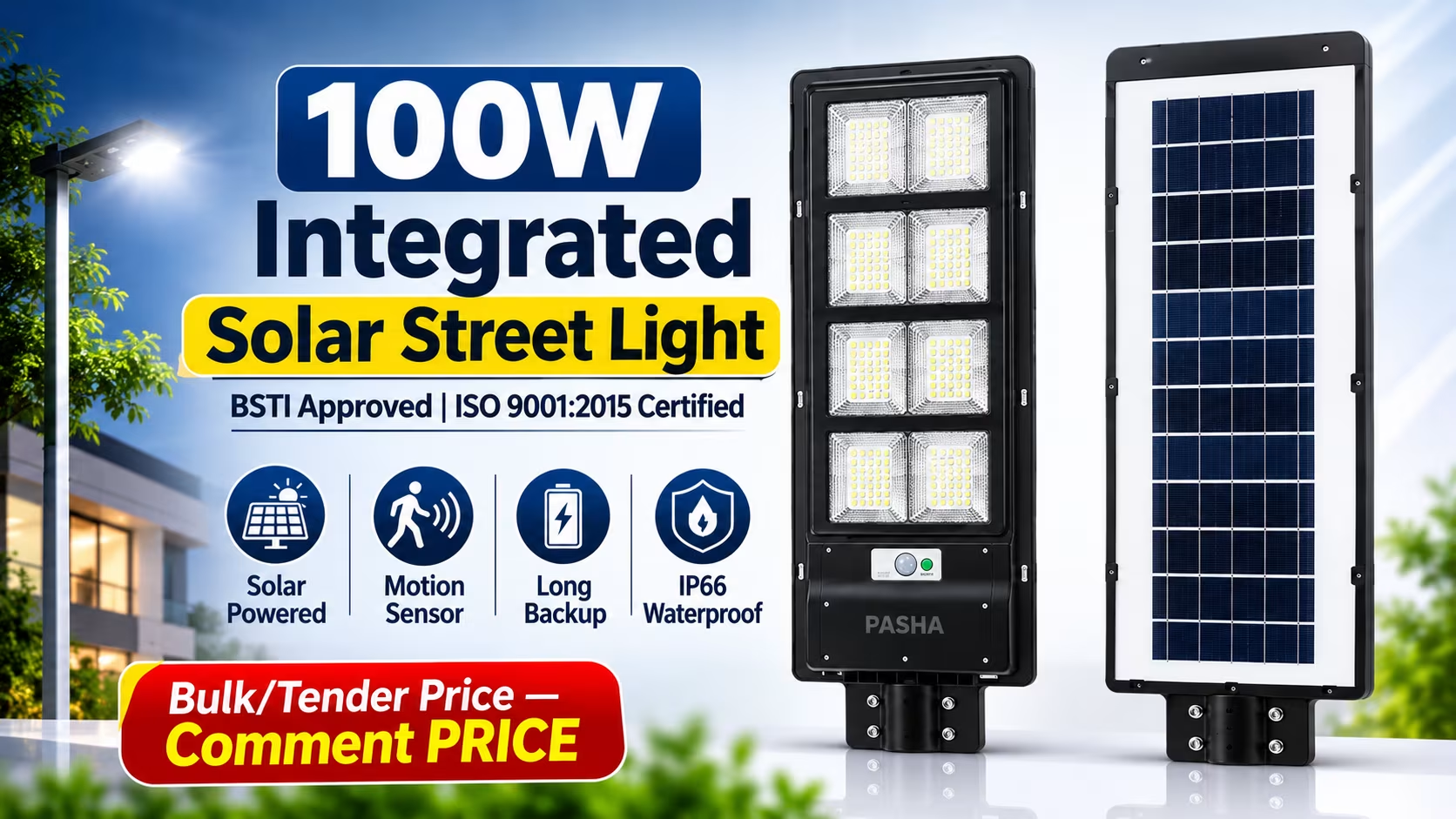
Solar street lights have become the default choice for new road, highway, and residential lighting projects across Bangladesh — and for good reason. With rising grid electricity costs and an increasing push from LGED, PWD, and other government bodies toward sustainable infrastructure, solar street lighting now accounts for a growing share of public lighting tenders nationwide. If you’re a government procurement officer, LGED/PWD contractor, or real estate developer evaluating solar street light price in Bangladesh for an upcoming project, this guide breaks down everything you need — from wattage selection to tender-ready pricing.
How Solar Street Lights Work – Solar street light price in Bangladesh
A solar street light is a self-contained lighting unit that doesn’t depend on grid power. It consists of four core components:
- Solar Panel (PV Module): Mounted on top of the pole, it absorbs sunlight during the day and converts it into electrical energy.
- Battery: Stores the generated energy (commonly Lithium Iron Phosphate/LiFePO4 or Lead Acid) for use after sunset.
- LED Light Fixture: The energy-efficient light source — typically 30W to 120W depending on application.
- Controller: Manages charging/discharging cycles, dusk-to-dawn operation, and in advanced models, motion sensing to extend battery life.
Because the entire system operates independently of the national grid, solar street lights are ideal for rural roads, highway corridors, and areas where grid connection is costly or unreliable — a major reason LGED and PWD increasingly specify solar options in rural electrification and road safety tenders.
Wattage & Lumen Guide: Roads vs Residential Areas
Choosing the right wattage is the single biggest factor affecting both performance and price. Here’s a practical breakdown:
| Application | Recommended Wattage | Lumen Output | Pole Height |
|---|---|---|---|
| Residential streets/lanes | 30W–50W | 3,000–6,000 lm | 4–6 meters |
| Secondary roads | 60W–80W | 6,000–9,000 lm | 6–7 meters |
| Highways/main roads | 100W–120W | 10,000–14,000 lm | 7–9 meters |
| Industrial/commercial zones | 100W+ | 10,000+ lm | 8–10 meters |
For government tender specifications, LGED and PWD typically mandate a minimum lux level on the road surface rather than just wattage — so panel size and battery backup (autonomy days) matter as much as the LED wattage itself.
Solar street light price in Bangladesh (By Capacity)
Pricing varies based on wattage, battery type, and specification compliance. As a general market reference:
- 30W Solar Street Light: Entry-level, suited for residential lanes and footpaths
- 50W–60W Solar Street Light: Mid-range, common for secondary roads and community areas
- 80W–100W Solar Street Light: Standard for main roads and government tender projects
- 120W Solar Street Light: Premium tier, used for highways and large commercial/industrial zones
Bulk/tender pricing is typically quoted per unit and drops significantly at volume — reach out directly for a project-specific quotation since government and corporate orders are priced differently from single-unit retail.
Factors Affecting solar street light price in Bangladesh
Several variables influence the final quoted price beyond wattage alone:
- Battery Type: Lithium (LiFePO4) batteries cost more upfront but last significantly longer (5–8 years) and perform better in Bangladesh’s humid climate compared to Lead Acid batteries, which are cheaper initially but need replacement every 2–3 years.
- Solar Panel Quality: Monocrystalline panels offer higher efficiency in lower sunlight conditions (important during monsoon season) compared to polycrystalline panels, affecting both price and year-round reliability.
- Pole Height and Material: Galvanized steel poles rated for cyclone/wind-load resistance cost more but are essential for highway and coastal installations.
- All-in-One vs Split Design: Integrated (all-in-one) solar street lights are more affordable and easier to install, while split-type systems (separate panel, battery box, and fixture) suit larger installations with higher autonomy requirements.
- Autonomy Days: Systems designed to operate 3–5 cloudy/rainy days without sun cost more due to larger battery and panel sizing — a critical spec for Bangladesh’s monsoon months.
Why BSTI/ISO Certification Matters for Government Tenders
For any LGED, PWD, HED, or CAAB tender submission, certification isn’t optional — it’s a compliance requirement:
- BSTI Approved products meet Bangladesh’s national quality and safety standards, a prerequisite for most government procurement.
- ISO 9001:2015 certification confirms the manufacturer follows a consistent, audited quality management process.
- RoHS Compliant products meet international standards for restricted hazardous substances, increasingly referenced in modern tender documentation.
Uncertified or unbranded solar street lights may appear cheaper on paper, but they carry real risk: tender disqualification, early battery failure, and warranty disputes. For procurement officers, certification documentation should be verified and attached at the quotation stage — not after award.
ROI & Energy Savings Calculation
Solar street lights eliminate ongoing electricity bills entirely, making the ROI calculation straightforward:
- A typical 80W grid-powered street light running 11 hours/night consumes roughly 0.88 kWh/day — translating to a real monthly electricity cost per pole when multiplied across a project (hundreds of poles on a highway stretch adds up fast).
- Solar systems have zero recurring energy cost after installation; the primary ongoing expense is battery replacement every several years (longer with lithium).
- For large-scale government road projects, the breakeven point against grid-connected lighting is typically reached within 2–4 years, after which the solar system operates at near-zero cost for the remainder of its 8–10 year lifespan.
- Additional savings come from reduced cabling/trenching costs, since solar poles require no underground electrical wiring — a major cost factor in rural and highway projects.
Installation Considerations
- Site Orientation: Panels should face south (in Bangladesh) with minimal shading from trees or buildings for maximum daily charge.
- Foundation and Pole Spacing: Spacing is typically 25–35 meters between poles depending on wattage and required lux uniformity — verify against the specific tender’s lighting design.
- Monsoon Readiness: Battery autonomy and panel tilt angle should account for Bangladesh’s extended cloudy periods (June–September).
- Maintenance Access: Battery compartments should be installed at an accessible height for maintenance teams, not just the panel.
FAQs
Q: What wattage solar street light is required for LGED road projects?
A: Most secondary and main road LGED specifications require 60W–100W depending on road width and required lux level; always confirm against the specific tender document’s photometric requirements.
Q: Can solar street lights work during Bangladesh’s monsoon season?
A: Yes, provided the system is sized with sufficient battery autonomy (3–5 cloudy days) and panel wattage headroom — this is a key spec to confirm before procurement, not after installation.
Q: What’s the typical lifespan of a solar street light system?
A: 5–10 years for the overall system, with lithium batteries lasting 3–8 years and panels/fixtures often outlasting that with proper maintenance.
Q: Do solar street lights require a grid connection as backup?
A: No — properly specified solar street lights are fully autonomous and don’t require grid backup, which is a major reason for their adoption in rural and off-grid tender projects.
Need a Bulk or Tender Quotation?
Planning a government tender, highway project, or large residential development? Get BSTI/ISO-certified solar street light pricing tailored to your project’s wattage, pole height, and quantity requirements. Contact PASHA Energy today for a tender-ready quotation and technical specification sheet.